
In times of unprecedented uncertainty, your past experiences are obsolete. Here is the clinical mechanics of how to reprogram your brain's gatekeeper to spot new opportunities hidden in the chaos.
The global environment provides an unlimited, overwhelming amount of data. However, due to the strict energy limitations of the human brain, we can only process a microscopic fraction of it.
We are biologically wired to ignore what we do not care about and focus exclusively on what we do. Specifically, we scan the environment for two things: threats and opportunities.
But who decides which is which? Why can two executives look at the exact same volatile market data—one sees a catastrophic threat, while the other sees a multi-million dollar acquisition opportunity?
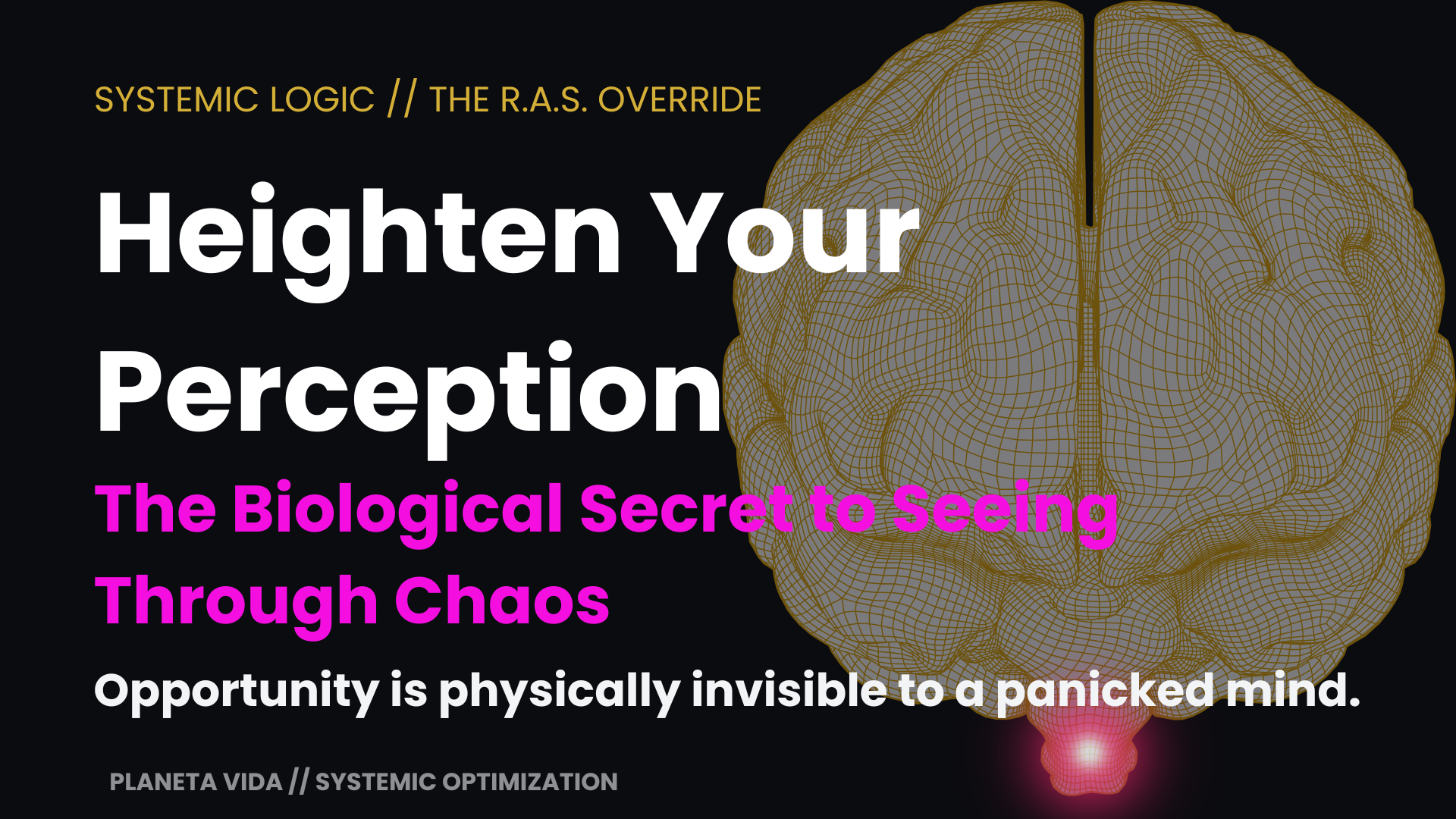
The answer lies in a network of neurons at the base of your brainstem: The Reticular Activating System (RAS).
The Brain’s Gatekeeper
The RAS is the gatekeeper of your consciousness. It regulates arousal and filters the infinite noise of the world so you can focus. To do this, the RAS constantly communicates with two other key structures: the Hippocampus (your long-term memory center) and the Amygdala (the control center for your basic instincts and emotional reactions).
When new data enters your environment, the RAS instantly consults your Hippocampus and Amygdala. It looks at your past experiences and the emotional reactions you attached to them. It uses this historical data to label the new event as a "Good Experience" or a "Bad Experience."
This means we do not see reality as it is. We filter reality based on the past.
The Chemistry of Action: Distress vs. Eustress
When your RAS spots something it identifies as a threat, your body enters a state of Distress. When it spots an opportunity, it enters Eustress.
Here is the clinical secret most professionals do not understand: Both processes release the exact same chemicals. Whether you are in Distress or Eustress, your system floods with cortisol, adrenaline, and noradrenaline to increase your energy levels for action.
The difference lies entirely in the emotional frequency that drives the action:
- Distress drives low-frequency emotions: fear, anxiety, anger, jealousy, and rage. If your actions are driven by these emotions, your perception will be one of pure survival. Every task will feel like striving, friction, and climbing a mountain.
- Eustress drives high-frequency emotions: motivation, curiosity, passion, and intense, disciplined focus. When driven by Eustress, you thrive. Complex execution feels effortless. Life and business become a journey to navigate, rather than a war to survive.
Your emotions are the drivers of your actions, and how your RAS filters the data dictates your emotional state.
The Trap of the Past in a New Paradigm
This biological process works flawlessly—until you enter a period of massive, unprecedented uncertainty.
Right now, the global economy is emitting mixed signals and opposite triggers simultaneously. What do you do when the current moment has absolutely nothing to do with your past memories?
In times of deep chaos, your past memories and old opinions are obsolete. They are based on a reality that no longer exists. If you rely on them, you will recycle old thinking patterns. When those old patterns fail to map onto the new reality, you will feel like you are going through hell.
But you are not in hell. You are simply suffering because your old software cannot process the new hardware. In a new paradigm, only the present moment can provide the clues on what to do next. You must integrate new real-time data, not rely on recycled opinions.
The 90-Second Recalibration Protocol
The first step to detaching from obsolete opinions is mastering the biological pause.
When you are hit with a chaotic market signal and you feel low-frequency emotions (fear, anxiety) begin to rise, pause for exactly 90 seconds.
Do not try to make sense of the situation. Simply wait. It takes roughly 90 seconds for the initial chemical wave of adrenaline and cortisol to flush through your bloodstream. Once the biological reaction passes, look at the problem again. Take your time to process the real-time data. You will suddenly see pathways and solutions that were physically invisible to you during those first 90 seconds.
The Law of Coherence
The ultimate secret to navigating uncertainty is to respond, not react. And you must wait to act until the solution your brain presents matches how you feel.
Your thinking process must be coherent with your emotions. You cannot successfully execute a strategy if your mind says "we need to pivot," but your body is radiating fear. Fear indicates your biology is uncertain about the decision.
Do not force the action. Wait for your brain to synthesize a better plan—one that triggers a high-frequency emotion like confidence, curiosity, or passion. The mental process must create a high-frequency emotional state before you act.
Moving from biological panic to unified execution is the defining skill of the modern executive. It is the journey Through Chaos to Coherence.
Prepare your biology. The opportunities are already here.